Covich, WVU build golf program from scratch
By Justin Hough, Chris Jackson and Colin Spangler
Sean Covich literally had nothing.
The West Virginia golf head coach walked into an empty barrel his first day on the job when he was introduced as the new coach on May 22, 2014. It was the reincarnation of the WVU golf program, which had not been in existence since 1982. That meant he needed to start everything from scratch.
So, Covich created a checklist. First off, he needed an office. He needed an official golf ball for the team. He needed golf courses where his team could play and practice. He needed to recruit players to make the team possible. And he needed to coordinate with other schools to make a tournament schedule.
“I was thinking about it the other day, like there’s a lot of good in starting from scratch because it’s fresh and you get to sort of do what you want, but then there’s also a lot of bad,” Covich said. “Just a lot of heavy lifting and just things that are not fun the first few years.”
Two of those required extra attention, though. Covich needed to get a schedule complete right away. He needed to recruit right away.
Building a schedule
There were issues in terms of scheduling. Strength of schedule is always a major talking point in college sports. That aspect can become the final determining point on if your team makes it to the NCAA Tournament or not because if two schools have the same results, but one of them has the tougher schedule, then the committee will opt to select the team with the more challenging schedule.
How would competing against a team starting from scratch help you at all? Who would even be on the team?
Opposing coaches had absolutely no idea what WVU was going to be.
“They weren’t sure what we were going to look like, what our team was going to be like,” Covich said. “Was it just going to be like five walk-ons or what was it going to be?”
Luckily, WVU founds schools that wanted it to compete. During the inaugural campaign in 2015-16, the marquee tournaments were the Graeme McDowell/Shoal Creek Invitational hosted by UAB and the Mason Rudolph Championship hosted by Vanderbilt.
“That was probably the most difficult, but we got a few breaks the first year,” Covich said.
Recruiting golfers
Finding those golfers to have a team to compete with was quite the obstacle. It was not like Covich had a brand he could recruit with. WVU spent more than three decades without a golf program. There was no tradition. It did not have the credibility of other places like a Texas or an Oklahoma.
By the time Covich started hitting the recruiting trail, he said he was three-four years behind. Some were committed to schools. Some were already visiting other schools that featured both facilities and an already established program. WVU had neither.
Covich was tasked on selling them with one critical idea: start something new. Build something special. Be apart of something that has never been done before.
“There’s a lot of college golfers that get to experience college golf, but not many get to experience a program from scratch, especially the very first year of competition,” said WVU senior Tristan Nicholls. “I took that as an opportunity to have a unique experience.”
At a place like WVU, playing golf is not a year-round experience outdoors. The weather in the winter months is miserable. The cold weather makes it difficult to play outdoors 365 days out of the year compared to warmer climates in places like California, Florida and Texas.
That means recruiting golfers that have backgrounds playing in colder climates is essential.
“If we go after a kid from Texas or from Florida, that might fit in great at Texas or Oklahoma U., but they might not fit in here,” Covich said. “I think that’s where it starts. It’s like ‘look, you’ve got to find your identity and players.’ That’s where it all starts.”
The roster showcases mainly those from colder weather locations. One golfer hails from Pennsylvania. One is from Virginia. One is from Germany. Two are from Canada. One came from Australia. Another from Georgia. And one from North Carolina.
“I think they need to almost come from cold weather backgrounds because that’s what we’re going to have to deal with,” Covich said.
Finding home(s)
This part was essential.
Although it was not as immediate of an obligation for Covich like recruiting and scheduling was, it was nearly as important. He would find multiple courses that he and his team could utilize.
Sometimes WVU practices at The Pines in Morgantown. Sometimes the team travels to Bridgeport to play at Pete Dye Golf Club. Sometimes it will practice at Stonewall Resort in Roanoke. Other times it will travel to Farmington, Pennsylvania, to play the courses at Nemacolin Woodlands Resort.
There is a reason why the Mountaineers only use each place on occasion. It depends on what upcoming tournament they are competing in. They want to practice somewhere that can prepare them the most for where they will compete next.
“The Pines is very old school,” Covich said. “You make a lot of birdies, get a lot of confidence. So for going to a course that’s old school, we play here a lot. If we’re going somewhere hard, we’ll play Mystic Rock or Stonewall or Pete Dye, so I think it helps us.”
The only problem is that WVU does not have a permanent facility to currently use, but that is set to change soon.
Instead of having to travel in a van all over to different courses to practice, it will have its own place. WVU will finally have an official home instead of relying primarily on local courses.
Athletic director Shane Lyons announced in August a $5 million project to create a state-of-the-art home for the Mountaineers. The facility, located off of the exit 146 on Interstate 79, will include a team clubhouse/locker room, short game area, six indoor hitting bays, a driving range, a putting green and a multiple green practice course.
What makes this different, though, are the practice holes. A driving range can only do so much. Sure, you can work on your swing, but it does not prepare you adequately enough for a round on the course.
They can create different shots, switch tee and hole locations, set up different lies whether it is an uphill, sidehill or downhill lie. They can put bunkers or water in the front.
Dark first days to now
Once Covich found the golfers he was looking for, found the courses to practice at and built a schedule, it was time to compete.
The first year was not easy, though, and it showed in the results. WVU finished better than 10th place only three of the 10 regular season competitions it went to. There was also a last place finish at the Big 12 Tournament.
That was to be expected. The first year is always rough.
Depth was an obvious concern. So was talent and chemistry. Training was a problem. How they did things in the weight room was not always the perfect way to do it. Plus, there was no understanding of how to balance out a schedule.
“My first year it was always just ‘go, go, go, go, go,’ and there wasn’t any time to relax and get away from it a little bit,” Sear said. “I find you need that to be able to perform your best when the time comes. Basically we’ve fixed those issues and I’m hoping that we keep trending in the right direction.”
Since then, things have certainly changed, and they have changed in a hurry.
During that second season in 2016-17, WVU made history. After coming out with a fourth place finish on the first day, it ended up climbing its way to winning the East Carolina Intercollegiate.
“Our coach always preaches about how to handle adversity and the boys rallied back, and the next thing you know we were sitting in there eating lunch and our names are at the top of the leaderboard, West Virginia, so it was just such a great feeling to actually see the team come together and get the job done,” Sear said.
WVU ended up claiming two more tournament wins the following year in 2017-18, showing just how far the program has evolved since the very first days when it was in existence. It won Janney VCU Shootout to begin the season and then it won the Martin Downs Collegiate hosted by UNC-Greensboro.
“Being just the second year of a program, we beat a few really good teams that have been around for a very long time,” Nicholls said. “To do that is just really positive for the future. And then the following year to get a few more wins just shows that we are definitely going places and that WVU golf has a bright future.”
There is a consensus between the golfers and Covich: WVU continues to trend upward. There have been three tournament wins during the last two seasons. Not a bad feat for a completely revamped program.
Not only that, but with the new facility being scheduled, it can only help the trajectory of WVU golf.
“Once we get the facility built, I don’t know how long it’s going to be, guys are going to want to come here,” Sear said. “Sports are taken so seriously here and the atmosphere is so great. People will realize ‘wow, West Virginia will be a great golf school to go to.’”
WVU Golf History
West Virginia’s natural beauty makes it an amazing destination not just for tourists but for both professional and casual golfers as well. The state has a golf history that dates back to the late 1800’s. In 1884 the Oakhurst Links in White Sulphur Springs became the very first public golf course in the United States. Since the Oakhurst Links opened, the state has continued its history of professional tournaments and beautiful golf courses over the years. The West Virginia Amateur Championship and West Virginia Open are the two most notable golf tournaments across the state. These tournaments as well as courses such as the Greenbrier have attracted many golf pros to the Mountain State. With such a rich history, it was only a matter of time before West Virginia University reinstated its golf program.

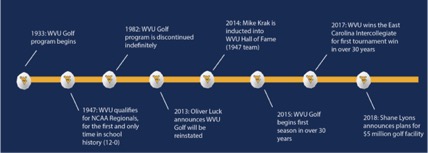
The program began in in 1933 and got off to a bit of a slow start. Building a program from the ground up is no simple task. Just like with the current rebuild, finding a solid footing and competing against already established programs proved to be a challenge. Therefore the program remained mostly stagnant until the 1947 team lead by all time Mountaineer Golf great Mike Krak. The 1947 team finished with a 12-0 match record and qualified for the NCAA regionals for the first and only time in school history, making this arguably the best season ever for WVU Golf. The team’s leader, Mike Krak, played golf at WVU from 1944 to 1948. Krak originally planned to join the WVU basketball team, but it was already loaded with talented players. He then decided to turn his athletic talents to golf instead. After playing golf for the Mountaineers, Krak found a job as an assistant golf professional at Canterbury Golf Course in Cleveland, Ohio. Krak joined the PGA Tour in 1954 and played in 15 majors, with his best performance being at the Dallas Athletic Club where he tied for 34th. He was also the back-to-back winner of the PGA Championship long drive competition in 1956 and 1957. Throughout his career, Krak played in nine PGA Championships, five U.S. Opens and one British Open. In 2014, he was inducted into the WVU Sports Hall of Fame, becoming the only golf player to do so.

Throughout the next 30 years or so, the WVU golf program continued with occasional success and a few notable teams. The 1952 team was able to secure seven wins in 12 matches on the season. The program also had standout teams from 1965 to 1968, but the program was mostly mediocre during the 70s and early 80s. The program was then discontinued indefinitely in 1982 because of a lack of success, funding and general interest. Since the golf program was already in a tough spot, it unfortunately ended up at the top of the list of sports to cut.


(Pictures from West Virginia and Regional History Center)
In 2015, WVU Athletic Director Oliver Luck announced that the WVU golf team would be reinstated. Luck stated that the history of golf in the state and the prestigious golf programs in the Big 12 conference lead to the reinstatement decision. Sean Covich was named the schools 12th golf coach and has lead the Mountaineers into this era for the program. In 2017, the Mountaineers secured their first tournament victory since restarting the program three years ago. In 2018, current Athletic Director Shane Lyons announced the plans for a $5 million golf facility, solidifying the schools commitment to the program.
 Chris Jackson